
Step 1 of the pipeline · Characterization
SEIDR
A portable RF characterization and vulnerability assessment lab.
- Who has this problem
- Units and integrators receiving RF payloads or commercial devices with no datasheet and no confirmed behavior on the air.
- What they do today
- Ship hardware to a lab in CONUS and wait, or fly it unverified and discover its emissions signature in the field.
- What today costs
- Weeks per payload, an unknown signature at the moment of use, and no visibility into whether the device is exploitable.
What changesFull characterization in under 60 minutes, in theater. Center frequency, output power, channel plan, modulation, spurious emissions, and duty cycle, with vulnerability assessment against 16 CVE-mapped profiles in the same session.
What SEIDR does
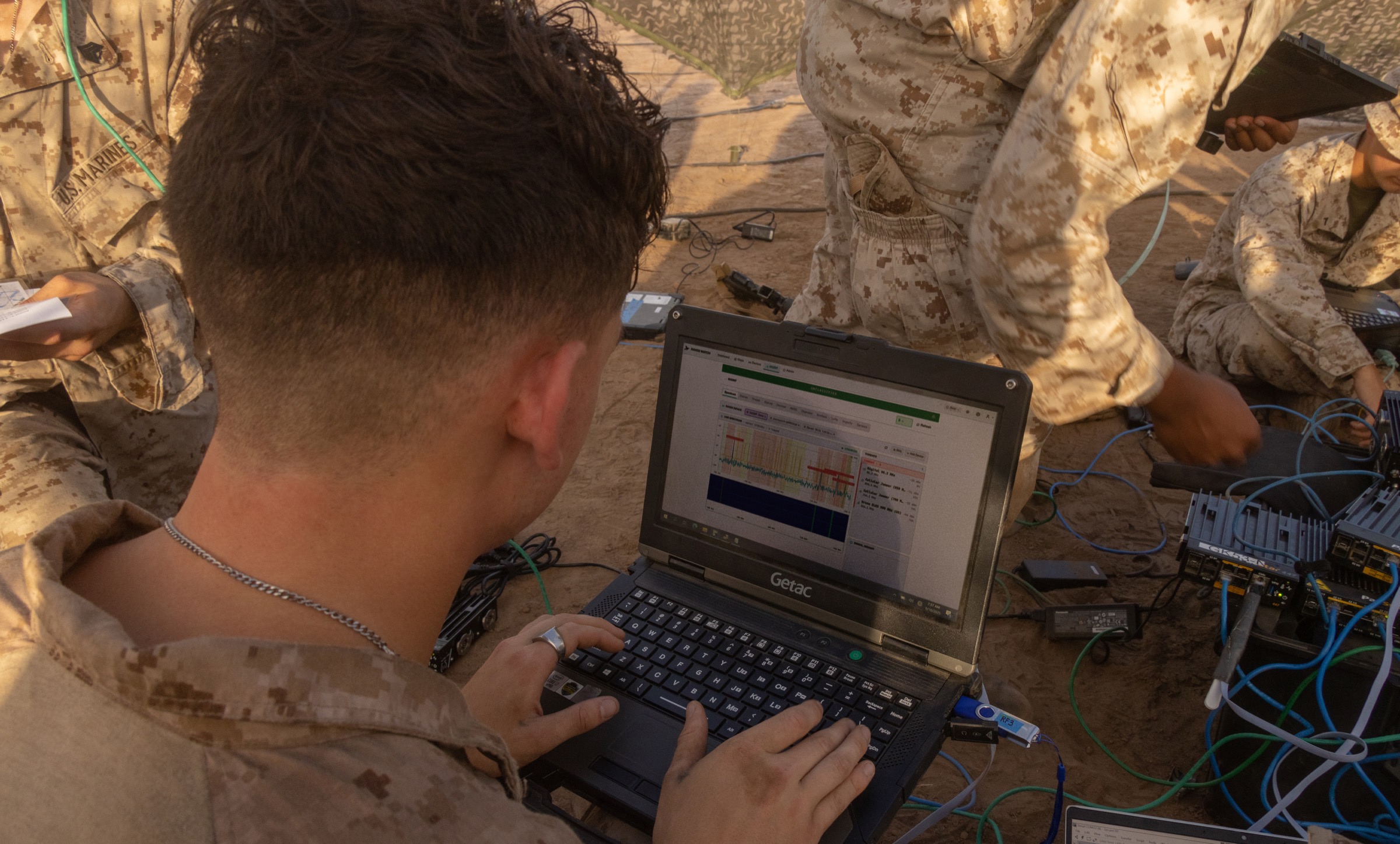
Real-time spectrum display
Replaces a full RF bench with a single handheld sensor. Current sweep, max hold, noise floor, and signal tag overlays render live. Field integration work, no lab required.
Payload RF characterization
Center frequency, output power, channel plan, modulation type, spurious emissions, and duty cycle. Any COTS or proprietary device, datasheet or not.
LoRa deep analysis
Validate a LoRa C2 link before the first flight. All 80 US915 channels, spreading factor estimation, burst detection, device fingerprinting, and duty cycle analysis.
Built-in vulnerability assessment
Know whether a payload is exploitable before it goes operational. 16 vulnerability profiles mapped to published CVEs, with real-time detectors running every sweep. No separate tool needed.
RF health monitoring
An adaptive median baseline per payload, with predictive alerts on frequency drift, power instability, and modulation degradation.
Electromagnetic order of battle
Walk away from every session with a full EOB of the RF environment. Exports to JSON, CSV, or KML and drops straight into ATAK via CoT.
Generated runbooks and playbooks
Every characterized payload comes with its own runbooks, playbooks, and quick reference cards, tailored to the unit's hardware, threat environment, and mission profile.
Training simulation
Ten scenarios from apprentice to master. Synthetic RF threats injected into the live pipeline, so operators train on the exact procedures they will execute in the field.
SEIDR+
The same system, scaled from one sensor to a fleet.
A ring of autonomous SEIDR Raven nodes covers a volume instead of the area in front of a single sensor. Each Raven scans independently; SEIDR+ fuses every feed into one operating picture and adds the one thing only a fleet can do, which is locating an emitter by the difference in when each Raven heard it.
Multi-band detection across the full drone spectrum
Ravens sweep 915 MHz, 1.8 GHz, 2.4 GHz, and 5.8 GHz and hold every band at once, so several airframes on different links are tracked simultaneously rather than one band at a time. Verified against live drones in a four-node field deployment.
Cross-raven TDOA positioning
Three or more GPS time-locked Ravens carrying time of arrival place an emitter by geometry rather than by bearing estimate. A position is produced when the observations support one, and withheld when they do not.
Airframe identification by RF fingerprint
Live spectrum is scored against a merged signature corpus covering DJI airframes and controllers, published research datasets, and this program’s own field captures. A credible match names the model.
Identification of airframes with no signature
An emitter on a known drone band that is localised between the Ravens and moving is flagged as a probable drone with no fingerprint required. This is the case a signature database cannot cover: a novel airframe still flies.
MANET datalink recognition for Blue-UAS deconfliction
Wide, continuous occupancy in non-consumer L and S band is classed as a tactical mesh datalink, which is how most US and allied Blue-UAS airframes appear on the air. Naming the class turns an off-band emitter into a deconfliction decision.
Counter-UAS effector detection and attribution
A passive, observe-only layer that detects the other population in the volume: jammers, GNSS denial, spoofers, and protocol takeover kit. It classifies each by mechanism and attributes it to the drone track it is being employed against, so a test event can be reconstructed afterward.
GNSS attack detection on the ring itself
The same timing hardware that disciplines the Ravens reports when it is under attack, using receivers already fitted for time lock. The ring can tell you when its own position and time reference is being interfered with.
I/Q fingerprinting for emitter identity
Carrier frequency offset, I/Q imbalance, EVM, and SNR are measured per emitter, which distinguishes two units of the same model by the imperfections of their individual radios.
SAPIENT and TAK egress
The fused picture registers with a SAPIENT message handling application under BSI Flex 335 v2.0, and forwards Cursor on Target to the TAK ecosystem. The ring reports into the common operational picture the customer already runs.
Capture, replay, and after-action reconstruction
Sessions record to SigMF with I/Q and manifest export for offline analysis. A mission replays end to end, so an outcome is reviewed against what was actually radiating at the time.
Specifications
- Ring size, field evaluation
- Four autonomous Raven nodes
- Bands covered
- 915 MHz, 1.8 GHz, 2.4 GHz, 5.8 GHz
- Positioning
- Cross-raven TDOA, three or more time-locked Ravens
- Node uplink
- Per-Raven satellite backhaul over an encrypted overlay
- Interoperability
- SAPIENT BSI Flex 335 v2.0, Cursor on Target for TAK
- Capture formats
- SigMF, raw I/Q, signed manifest
- Signature corpus
- DJI airframes and controllers, research datasets, program field captures
- Detection ranges and sensitivity
- Available on verification
- Effector classification library
- Available on verification
Counter-UAS detection and attribution is a passive, observe-only capability. Transmission for test and evaluation is separately authorized, locally controlled at each Raven, and audited.
Specifications
- Characterization time
- Under 60 minutes per payload
- Display refresh
- 30+ FPS real-time spectrum
- LoRa analysis
- All 80 US915 channels, spreading factor estimation, device fingerprinting
- Vulnerability profiles
- 16, mapped to published CVEs
- Runbooks included
- 34 red team, 10 blue team
- Export formats
- JSON, CSV, KML, CoT for TAK
- Frequency coverage
- Available on verification
- Sensitivity and dynamic range
- Available on verification
A Full RF Engineering Lab in a Backpack.